
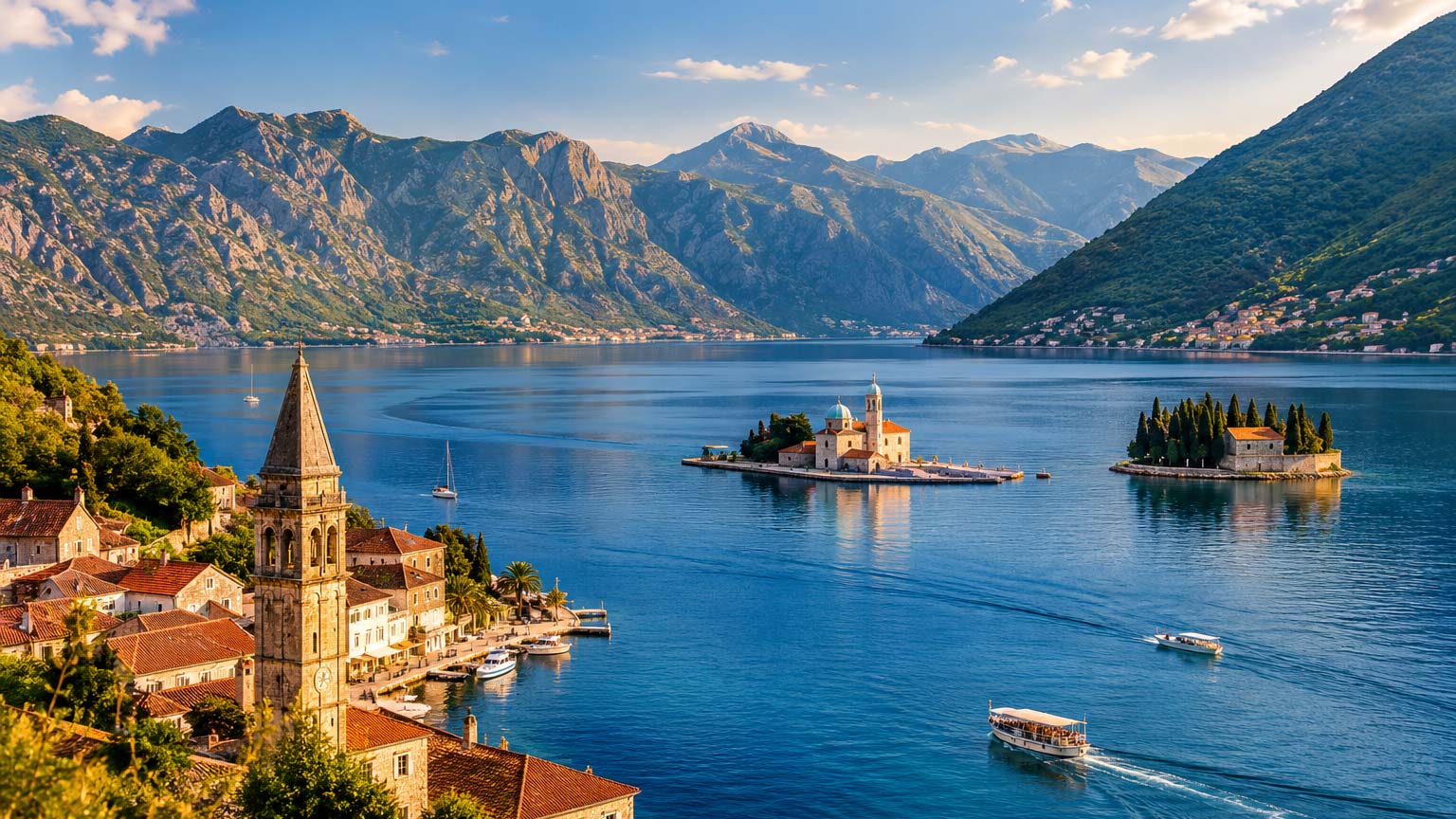

Discover the Historic Treasures of Montenegro
Explore the centuries-old towns, ancient fortresses, maritime heritage, and cultural landmarks that make the Bay of Kotor one of the Adriatic’s most fascinating destinations.
A Journey Through the History of Boka Bay
The Bay of Kotor, known locally as Boka Kotorska or simply Boka Bay, is much more than a beautiful stretch of the Adriatic coastline. It is a place where ancient civilizations, medieval trading towns, maritime republics, and diverse cultural traditions have shaped a unique historical landscape.
Located in southwestern Montenegro, the bay is surrounded by steep limestone mountains, picturesque fishing villages, historic churches, and fortified coastal towns. For centuries, its sheltered waters provided a natural harbour for sailors, merchants, and naval fleets travelling across the Adriatic and Mediterranean.
The region’s history reflects the influence of the Illyrians, Romans, Byzantines, medieval Slavic states, the Venetian Republic, the Ottoman Empire, and the Austro-Hungarian monarchy. Each left its mark on the architecture, traditions, and identity of Boka Bay.
Today, the Natural and Culturo-Historical Region of Kotor is a UNESCO World Heritage Site, celebrated for the exceptional preservation of its historic settlements, fortifications, palaces, churches, and surrounding landscape.
Whether you explore the region on foot, join a guided sightseeing tour, or discover the coastline by speedboat, Boka Bay offers an unforgettable journey through the past.
1. Kotor Old Town – A Medieval City Behind Ancient Walls
Kotor is the historical heart of Boka Bay and one of Montenegro’s most remarkable cultural destinations. Its origins reach back to antiquity, while its medieval development and centuries of Venetian rule shaped the town visitors see today.
Between 1420 and 1797, Kotor was under Venetian rule for most of the period, and the influence of Venetian architecture remains visible throughout its historic centre.
Walking through Kotor Old Town feels like stepping into another century. Narrow stone streets open onto charming squares, while historic churches, aristocratic palaces, and traditional buildings reveal the wealth and influence of the city’s former maritime community.
Historical highlights in Kotor include:
- St. Tryphon’s Cathedral – Consecrated in 1166, this Romanesque cathedral is one of the town’s most important landmarks.
- Kotor City Walls – A remarkable defensive system extending from the waterfront up the mountainside towards the Fortress of St. John.
- The Fortress of St. John – A spectacular viewpoint overlooking the rooftops of the Old Town and the winding coastline of the bay.
- The Maritime Museum of Montenegro – A fascinating introduction to the seafaring traditions, naval history, and prominent maritime families of Boka.
- Historic palaces and squares – Architectural reminders of the wealthy merchants, captains, and noble families who shaped the town.
Kotor is an ideal starting point for discovering the region, combining history, architecture, local cuisine, and easy access to boat excursions across the bay.
2. Perast – The Elegant Town of Sailors and Captains
Located along the shores of Boka Bay, Perast is one of the region’s most beautiful historic settlements. Its elegant stone palaces, Baroque churches, and waterfront promenade reflect the prosperity it enjoyed during the height of Adriatic maritime trade.
During the Venetian period, Perast became renowned for its experienced sailors, ship captains, and maritime traditions. Wealthy families built impressive residences along the waterfront, many of which remain part of the town’s distinctive architectural character.
Unlike the lively streets of Kotor, Perast offers a quieter atmosphere, making it an excellent destination for a leisurely walk, a waterfront meal, or a scenic boat trip.
Its most famous attractions are the two small islands just offshore: Our Lady of the Rocks and St. George.
Perast is also a wonderful place to appreciate the relationship between Boka Bay’s natural landscape and its maritime history. From the waterfront, visitors can enjoy magnificent views of the surrounding mountains and the deep blue waters that once carried merchant ships across the Adriatic.
3. Our Lady of the Rocks – An Island Built by Tradition
One of the most distinctive historical landmarks in Montenegro is Our Lady of the Rocks, known locally as Gospa od Škrpjela.
Unlike a natural island, it was created gradually by the people of Perast, who added stones and sank old ships around a reef over many generations.
According to local tradition, the story began in 1452, when sailors discovered an icon of the Virgin Mary on a reef. The discovery inspired the community to create an island and build a church dedicated to Our Lady.
Today, the island is home to a beautiful church and a small museum containing religious art, votive offerings, maritime artefacts, and other historical treasures. The interior is particularly notable for its Baroque paintings by Tripo Kokolja and its collection of objects connected with the seafaring history of Perast.
The island remains a symbol of faith, community, and the enduring connection between the people of Boka Bay and the sea.
How to visit: Small boats regularly connect Perast with Our Lady of the Rocks, making it one of the easiest and most rewarding historical excursions in the bay.
4. St. George Island – A Quiet Place Steeped in History
Close to Our Lady of the Rocks lies St. George Island, another of Perast’s famous landmarks.
Unlike its neighbouring artificial island, St. George is naturally formed. It is associated with a historic Benedictine monastery and a small cemetery traditionally linked with prominent families from Perast.
The island’s cypress trees and stone buildings create a distinctive silhouette against the surrounding mountains. Its secluded atmosphere contrasts with the lively waterfront and makes it one of the most recognisable sights in Boka Bay.
Access to the island is generally restricted, so visitors usually admire it from Perast or from a boat cruising across the bay.
5. Risan – Discover the Roman Heritage of Boka Bay
At the northern end of the inner bay, Risan offers a glimpse into the region’s ancient past.
The settlement was an important centre in the ancient world and is associated with the Illyrian kingdom before the Roman conquest. Its archaeological heritage includes remains from the Roman period, when settlements along the Adriatic developed through trade, maritime connections, and cultural exchange.
Risan’s most remarkable attraction is its Roman mosaic collection, including the famous mosaic depicting Hypnos, the ancient Greek god of sleep. These remains provide a rare insight into the private life, artistic tastes, and cultural influences of the people who lived in the region nearly two thousand years ago.
For travellers interested in archaeology, Risan provides a valuable historical contrast to the medieval architecture of Kotor and Perast.
6. Herceg Novi – Fortresses, Stone Streets, and Centuries of Rivalry
Positioned near the entrance to Boka Bay, Herceg Novi has a history shaped by its strategic location between the Adriatic Sea and the mountainous hinterland.
Founded in the medieval period, the town experienced periods of Ottoman, Spanish, Venetian, and Austro-Hungarian influence. These successive powers contributed to a remarkable collection of fortifications, historic buildings, and urban landmarks.
Among the most interesting places to visit are:
- Forte Mare – A historic seaside fortress overlooking the Adriatic.
- Kanli Kula – A hilltop fortress with commanding views over the town and bay, now also used as an open-air performance venue.
- Španjola Fortress – A defensive complex associated with the Spanish presence in the sixteenth century.
- The Old Town – A network of stone stairways, small squares, churches, and traditional Mediterranean architecture.
Herceg Novi is particularly rewarding for visitors who enjoy combining historical sightseeing with coastal walks and panoramic viewpoints.
7. Mamula Island – A Fortress at the Entrance to the Bay
At the entrance to Boka Bay, Mamula Island is dominated by a circular stone fortress built in the nineteenth century during the Austro-Hungarian period.
The fort was designed as part of a wider defensive system intended to protect the strategically important entrance to the bay. Its isolated position made it an imposing military stronghold.
During the Second World War, the fortress was used as a prison by Italian occupying forces, giving the site a darker place in the region’s history.
Today, Mamula is best appreciated as a landmark viewed from the sea. Boat tours around the Luštica Peninsula often include a view of the island alongside nearby coastal caves and historic military installations.
Visitors should check current access arrangements before planning a visit ashore, as access to the island and its facilities may be restricted.
8. The Submarine Tunnels of Luštica – A Glimpse into Military History
Along the Luštica Peninsula, visitors can discover hidden submarine tunnels built during the Yugoslav period.
These military installations were constructed inside the rocky coastline to shelter submarines and other naval vessels. Their entrances are often difficult to spot from land, making them particularly interesting to discover during a boat excursion.
The tunnels reveal another chapter in the history of Boka Bay, when its naturally sheltered waters and strategic position made it important for naval defence.
Many speedboat excursions combine the submarine tunnels with visits to Mamula Island and the Blue Cave, offering an unusual mix of military heritage and natural beauty.
The tunnels are best viewed from a suitable boat tour, and visitors should follow the operator’s safety instructions rather than entering restricted or unprotected areas.
9. Lovćen – Montenegro’s Mountain of History and Identity
Although it rises above the coast rather than directly on the waterfront, Lovćen is closely connected with the history and cultural identity of the Boka region.
The mountain overlooks the surrounding landscape and forms a dramatic backdrop to the Bay of Kotor. Its winding roads, panoramic viewpoints, and rugged peaks offer a striking contrast to the calm waters and historic coastal towns below.
The principal historical attraction is the Njegoš Mausoleum, located on Jezerski Vrh within Lovćen National Park. The mausoleum commemorates Petar II Petrović-Njegoš, the nineteenth-century ruler, poet, and philosopher who occupies a central place in Montenegrin cultural history.
Reaching the mausoleum involves a mountain drive followed by a climb up a long flight of steps. The reward is a remarkable panorama across Montenegro, with views extending towards the Adriatic on clear days.
A trip to Lovćen is an excellent choice for travellers who want to explore beyond the coastline and experience Montenegro’s mountain landscapes, history, and traditions.
10. Tivat and the Maritime Traditions of Boka Bay
Tivat offers another perspective on the region’s maritime heritage.
The wider area has long been connected with seafaring, shipbuilding, and naval activity. The nearby naval facilities at the Bay of Kotor played an important role during the Austro-Hungarian and Yugoslav periods.
Today, Tivat combines its maritime past with a modern waterfront atmosphere. Porto Montenegro, developed on the site of a former naval shipyard, reflects the continuing relationship between the town and the sea.
For visitors, Tivat provides a convenient starting point for boat trips, sailing excursions, coastal sightseeing, and exploration of the surrounding settlements.
11. Discover Boka Bay by Speedboat
While walking through historic towns is one of the best ways to appreciate their architecture, exploring Boka Bay by speedboat offers a different perspective on its history and geography.
From the water, visitors can see how fortified towns, churches, palaces, and small settlements developed along the shoreline. The mountains rise steeply behind the coastal villages, while the narrow passages between the inner and outer bays reveal the strategic importance of the region throughout history.
Depending on the route, a boat excursion may include:
- Kotor’s historic waterfront and surrounding mountains.
- Perast and the islands of Our Lady of the Rocks and St. George.
- The Verige Strait, the narrow passage connecting sections of the bay.
- Herceg Novi and the historic fortifications near the bay’s entrance.
- Mamula Island and the submarine tunnels of Luštica.
- The Blue Cave, famous for its luminous blue water.
A speedboat trip is particularly appealing to visitors who want to discover several locations in a single day without spending the entire excursion travelling by road.
For a more complete experience, combine a boat tour with a separate excursion to Lovćen, where Montenegro’s cultural heritage meets spectacular mountain scenery.
Plan Your Historical Journey Through Boka Bay
Boka Bay is a destination where history is not confined to museums. It is visible in the stone streets of Kotor, the palaces of Perast, the Roman remains of Risan, the fortresses of Herceg Novi, and the islands and military installations scattered along the coastline.
Each place tells a different part of the story: ancient settlement, medieval trade, Venetian maritime power, religious tradition, and modern military history.
Whether you have a few hours or several days, exploring these historic landmarks will help you understand why the Bay of Kotor remains one of the most distinctive cultural destinations in the Mediterranean.
Discover Boka Bay from the sea, explore its historic towns, and venture into the mountains of Lovćen to experience the many layers of Montenegro’s remarkable heritage.
Boka Bay is not just a destination to see — it is a story to discover.
0 Comment